
a taste of community breeding in italy

Experimental field day at Azienda Agricola Biologica Floriddia, May 2026. Photo: Adèle Violette
While developing seeds suited to the specific conditions of organic farming still faces significant challenges, multi-stakeholder breeding systems are proving effective in steering research towards greater diversity. Among them, the participatory approach branches out into numerous projects and living labs across Europe, aiming to create new varieties tailored to local needs.
Reporting from an experimental field day in Italy, Seeds4All project coordinator Adèle Pautrat explores the concept of participatory plant breeding, while agronomist Michael Daddio shares his inspiring thoughts on breeding as a tool to empower communities.
Author: Adèle Pautrat, and Michael Daddio. June 2026
Highly Radical, Even Subversive
Participatory Plant Breeding (PPB) is a collaborative approach where breeders, farmers, gardeners, bakers, brewers, and more work together to develop new crop varieties. Rooted in the principles of agroecology and seed sovereignty, PPB prioritises local knowledge and needs to adapt to specific environments, over exclusive criteria of uniformity and standardisation.
With the establishment of a system of power, authority, and control, there has been a process of expropriation of both genetic material and knowledge. Participatory plant breeding challenges this system and is therefore considered highly radical, even subversive. — Rete Semi Rurali in the Technical Sheet No. 30 on Participatory Research.
In Italy, Rete Semi Rurali implements the participatory approach to develop organic varieties of rice and wheat tailored to local diets, challenges, and farmers’ needs. It notes three main defining features:
- A largely decentralised process that mostly takes place in farmers’ fields.
- Decisions are made collaboratively by all the stakeholders involved in the process.
- The process can be implemented across multiple locations, engaging a large number of farmers and using diverse genetic material tailored to local preferences.
Buying and Buy-in
Leveraging the versatility of a multi-stakeholder approach, PPB emerges as a potential solution to a major challenge in organic plant breeding: the lack of funding.
“The usual option for funding private breeding is through intellectual property rights”, explains Riccardo Bocci, executive director of Rete Semi Rurali, in an interview conducted jointly by Seeds4All and SEED CARRIERS.
But because it is not uniform, organic heterogeneous material (OHM - i.e. diversified, reproducible seed populations that can be brought to market under the 2018 EU Regulation on Organic Production) cannot be protected or patented.
“The other common option would therefore be the market,” says Bocci. “But for your seeds to be viable on the market, you’d need to sell them to many farmers. If you want to develop something very specific for a limited area, the market will never generate enough revenue to cover what you’ve spent on breeding."
"You can imagine how long and complex the process of breeding for diversity is—it requires a lot of time, a lot of people, a lot of skills. So we have to find alternative ways to sustain it, and one possibility is PPB.”
“With the participatory approach, you are involving the actors—farmers, breeders, brewers, bakers—who will use the innovation once the innovation is ready, because they were part of the innovative process.”
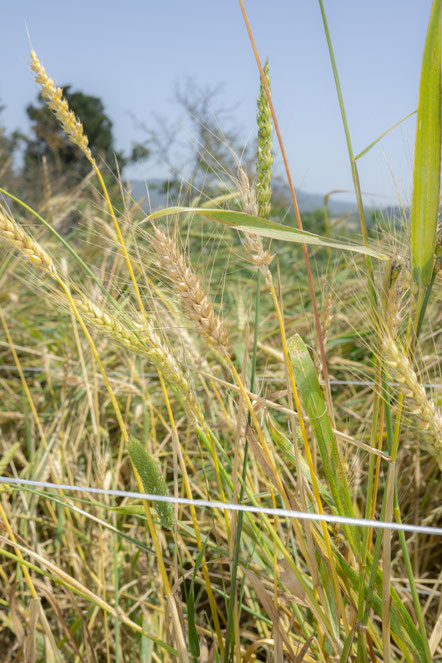
The "Furat" OHM on trial at Azienda Agricola Floriddia. Credit: Adèle Violette
More than Yield

“Another important dimension of PPB, is to not leave the breeding decisions to private companies and breeders alone,” continues Bocci. “Because most of these actors primarily care about the market, and their main concern is yield. They are not considering for example climate change, local adaptation, taste, or other qualities that could be good for some specific groups of people.”
Within the movement for seed diversity and autonomy, PPB is promoted as a way to empower communities, preserve and revive food traditions, and resist industrial seed monopolies. “We need to open up the breeding process through multi-actor approaches, and participatory plant breeding is one way to do it,” says Bocci. “In the United States, they have developed the similar concept of culinary breeding—which means that you are also involving chefs in the breeding process!”
To apply PPB in practice, Rete Semi Rurali collaborates with Azienda Agricola Biologica Floriddia, a successful leading Italian model example of mixed farming near Florence.
On the sidelines of the 2026 Let’s Liberate Diversity forum, the network gathered a group of international researchers, technicians, breeders, and farmers at the farm, to carry out a participatory evaluation of the organic wheat varieties under trial. Among them, we met agronomist Michael Daddio, who agreed to share with us his impressions of this experience:
Researcher Gabriella Aquije collecting seeds at Floriddia. Credit: Adèle Violette
Report from a Tuscan wheat field, by Michael Daddio
It was a hot day in late May on the Floriddia farm, and the inspiration was in full flow. Imagine the rolling Tuscan hills, gently swept by a cool breeze that moved through hectares of green, knee-high wheat fields like ripples through calm water. Then imagine a couple of bus-loads of agriculture enthusiasts being dropped off for a field-day of workshops, fresh pasta and science! More excitement than I ever thought possible at a wheat farm.
On the way there, as the bus rumbled along through the valleys, we were briefed on the activities of the day with a handout full of charts and diagrams. I recall looking down at it with a grin that could rival a kid on his way to Disneyland.
Terms like “phenotypic diversity”, “stem extension”, and “tribiome durum” popped out at me while I struggled through a weak 5G connection to determine their relevance. The impressive map of participatory breeding plots promised rich content with its numerous colour-codes and cryptic identifiers. We were about to go deep.
After a brief introduction, we divided into four groups to rotate through four sections of the breeding plots. With laser focus, we pressed our eyes as close to the scrawny stalks of organic heterogenous material as we could. It was our job to provide a naive narrative of characteristics like soil cover, density of ears, straw length, and, most importantly, overall appreciation.
Basic questions like “How high is too high?” and “Is this even the right plant to evaluate?” were tossed back and forth, eventually giving us confidence in our task. It was like learning to swim, but in the end I read through my notes scribbled with “good halm development” and “inconsistent height” with pride.
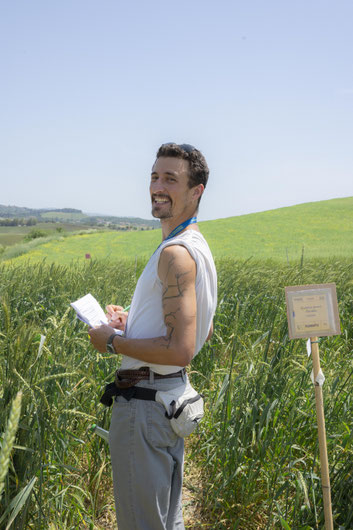
Michael Daddio in the OHM cereal plots. Credit: Adèle Violette
But it was the section with the least sensory demands that stuck with me the most. Dr. Bettina Bussi stood under her wide-brimmed sun hat between plots of soft and hard, genetically diverse wheat. As she began to speak, it became clear we were listening to a true master of grains. In the plots of thick, tall grass they were growing varieties from as far afield as Ethiopia directly next to local species. She explained the importance of genetic diversity as a foundational principle of the wheat being grown in the many hectares around us.
The drastic difference in the varieties was astounding and I found myself whipping out my phone to try and capture the beauty of the awns and kernels from all angles. A few dozen shots later, I was back with Dr. Bussi as she dropped the word “population”, one of my favourite topics in the modern wheat world. The genetically diverse wheat that stood before us was much more capable of adapting to its environment than a conventional, homogenous variety.
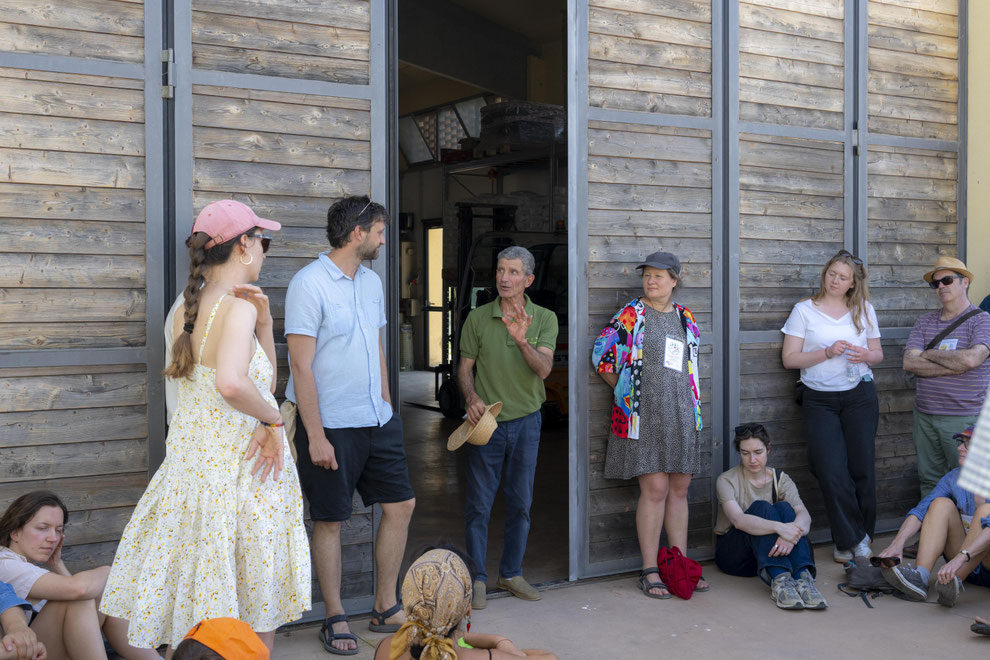
Rosario, the owner of Azienda Agricola Biologica Floriddia, tells the international group about the history of the farm and its wheat. Credit: Adèle Violette
The experiment went like this: one population of wheat was planted a decade ago in two locations, in Floriddia in Tuscany, and down south in Sicily. The populations would be maintained and allowed to develop naturally at each respective location. Ten years later, they would be reunited and planted next to each other in both locations to compare their performance. What was the result? Exactly as one might expect: each variety had adapted, growing quite poorly in the foreign environment, and absolutely wonderfully in its home soil. The genetic diversity had worked its magic in creating a robust, local grain that can withstand changes in weather conditions much better than its conventional cousins.
Locally adapted varieties are now a core feature that allows Florridia to flourish in a market dominated by industry giants. While conventional farms take huge losses in years with low yields and wasted investments in agrochemicals, Florridia triumphs with better yields and minimal risk due to low-intervention farming of naturally adapted wheat. Thanks to the vision of the founding farmer, Rosario, over the decades the farm has built a holistic model that now extends far beyond the farm gate.

Starting over 30 years ago with a dependency on CAP subsidies, Rosario began to engage with collaborators such as the University of Florence to develop an on-site mill, pasta making and bakery, all of which are now fully operational and the foundation of a successful enterprise.
During an inspiring tour of the facilities, Rosario explained how nutrition is a core principle of his breeding and farming approach.
With the capacity to mill and produce on the farm, they can showcase the best of what each of these special grains has to offer. Pasta on sale at the farm is made from the heritage organic wheat varieties Cappelli, Russello, Etrusco and Taganrog, whose combined proteins create a unique gluten structure, distinct from modern wheat and known to be more digestible.
While walking back to the farm house for what would turn out to be a magnificent lunch of pasta produced on-site with the very grains we observed, I pondered the sheer, simple beauty of what is being done here.
And I wondered why anyone would ever think of doing it differently.
The pasta we had for lunch, grown at the farm from seed to plate! Credit: Adèle Violette
“Trust your Gut Feeling!”
A visual report of the experimental field day, with impressions from participants

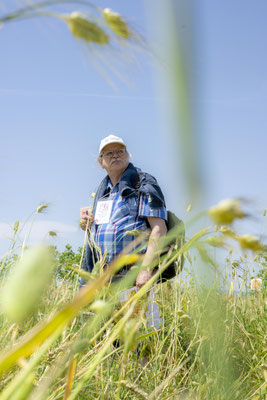
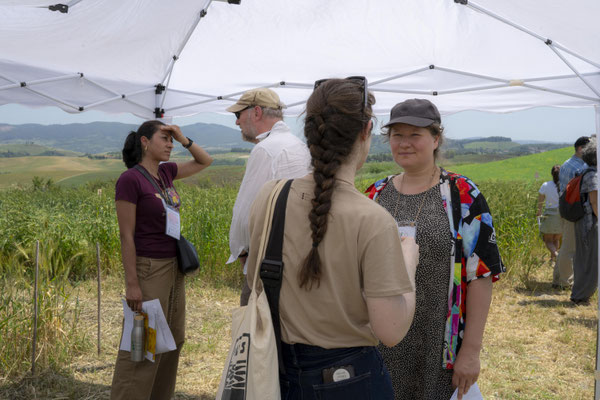
A group of international researchers, technicians, breeders, and farmers arrive at Azienda Agricole Biologica Floriddia, to carry out a participatory evaluation of the organic wheat varieties under trial.

Fernando, a member of Rete Semi Rurali, leads one of the four groups of participants through the participatory evaluation of some of the many ongoing trials. “At Azienda Agricola Biologica Floriddia, Rete Semi Rurali is testing and aiming at developing organic varieties that could compete with modern varieties, still commonly sown in organic farms," he explains. "Because in Italy we still don’t have good organic wheat varieties, so most farmers use modern conventional varieties with a derogation. To overcome this, farmers need newly bred organic varieties. And they are especially looking at some characteristics: early soil coverage, pests and diseases, weed development, as well as post-harvest parameters like yield quality, protein content, etc.”

Fernando gives his final advice to experimenters:“It’s an overall evaluation so basically you can evaluate the height, the colour, the presence of weeds, the ears’ density, the presence of pests or diseases…everything that you spot! Just trust your gut feeling!”
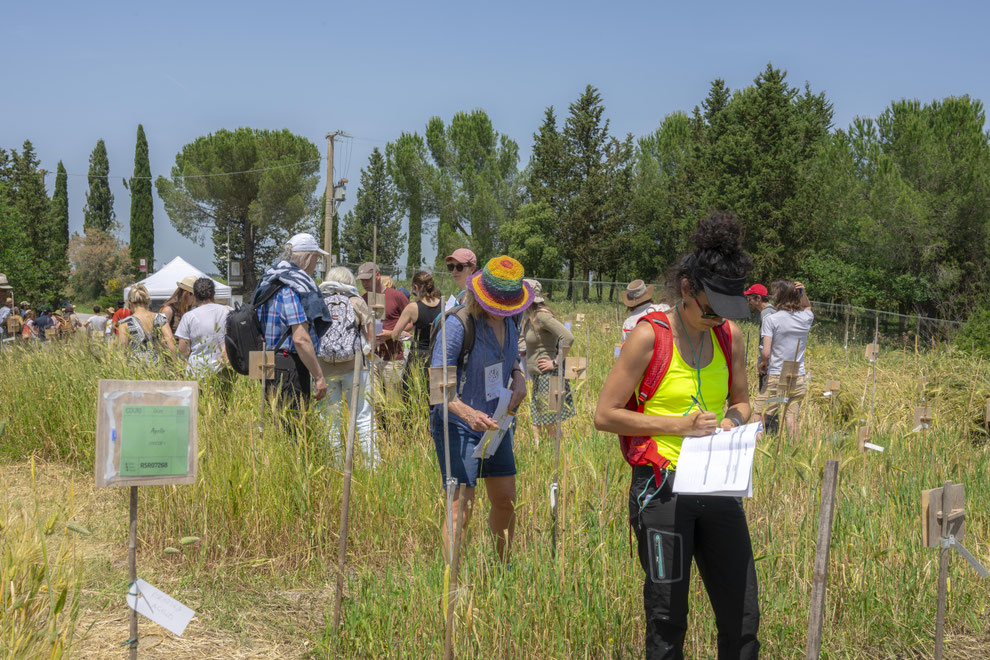
I can hear another Rete Semi Rurali host asking to her group: “Please decide for your two strips – then maybe have a little round, get a bit familiar with the different entries, you can find some background information on the little signs – and then you can start the activity!”

In addition to capturing photos of this highly inspiring moment, Seeds4All could collect participants’ impressions of the work they contributed!

“Here if you look at the height, this one is clearly a short variety, compared to most of the varieties around us. This gives some advantages but also many disadvantages, for example in terms of weed competition. If you look at the plot, you can see that it is quite covered by weed. Taller varieties would be more capable of withstanding weed competition way better. It is good that the soil is not exposed to the sun of course, but it could be covered by the crop itself. This is what interests farmers the most, to have a variety that is able to cover the soil in the early stages in order to withstand weed competition, and then, consequently, have a good yield at the end of the year.”
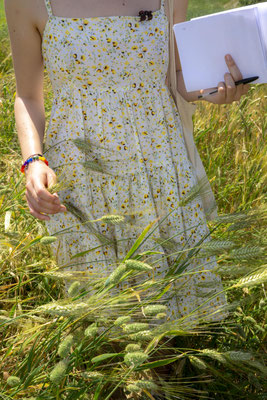

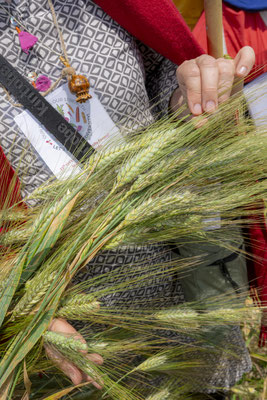
“I'm afraid that all these cereals are gonna look amazing to me…I might not be the best experimenter. This wheat here, the lady before me put a 2, but I find it so beautiful! I should first have a little round to then be able to compare all of them…”
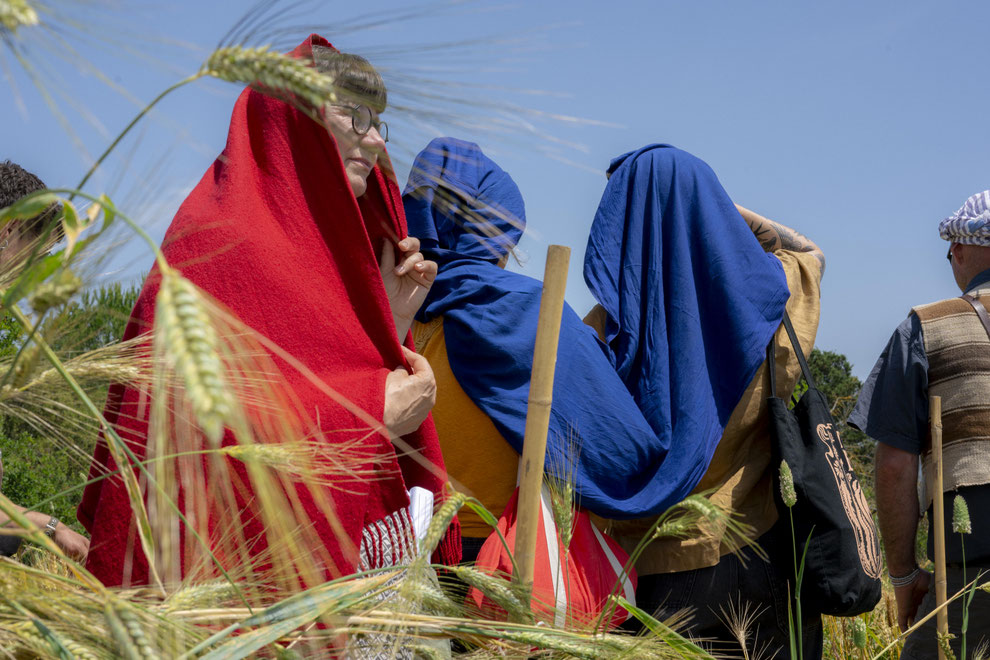
“This is a bit more complex than I thought it would be. But I'm absolutely enjoying it. I think it’s interesting to understand that, for our new eyes, it’s ok to be wrong about things."
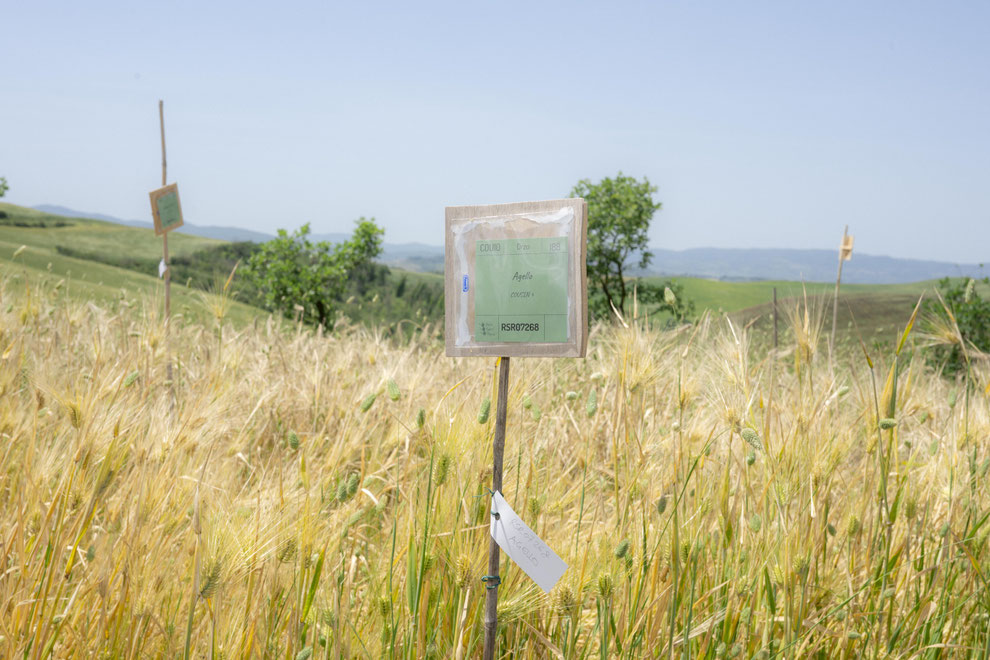
“It looks quite homogeneous I would say, and fine. Not such a long head. I haven’t scored it yet, but I think I will go for a 3. 4 is really good, and 3 is almost really good. In terms of the number of grains on the head, this one has fewer than others I’ve seen. It’s quite a nice size though. I guess it always depends on what you want from the wheat. This one is not that high which is perfect when you have a storm! It looks pretty resilient.”

“This one is the first one that we observe and I think that we will find better ones! It has some good benefits. You could probably harvest it early. But this, here, looks like there was a fungi. Well it’s empty now, I think it died some days ago.”
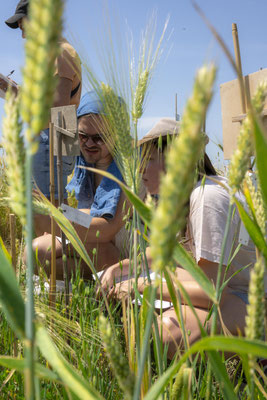
“Do you want to know the very professional criteria that I wrote down in my survey? [laughing] I put “very dense and chubby” and “nice to the touch”!”


All the photographs on this website were taken by professional photographers and are protected by intellectual property rights.
If you wish to reproduce them, please write to us and we will provide you with the necessary information. Thanks!