
In search of untasted flavours
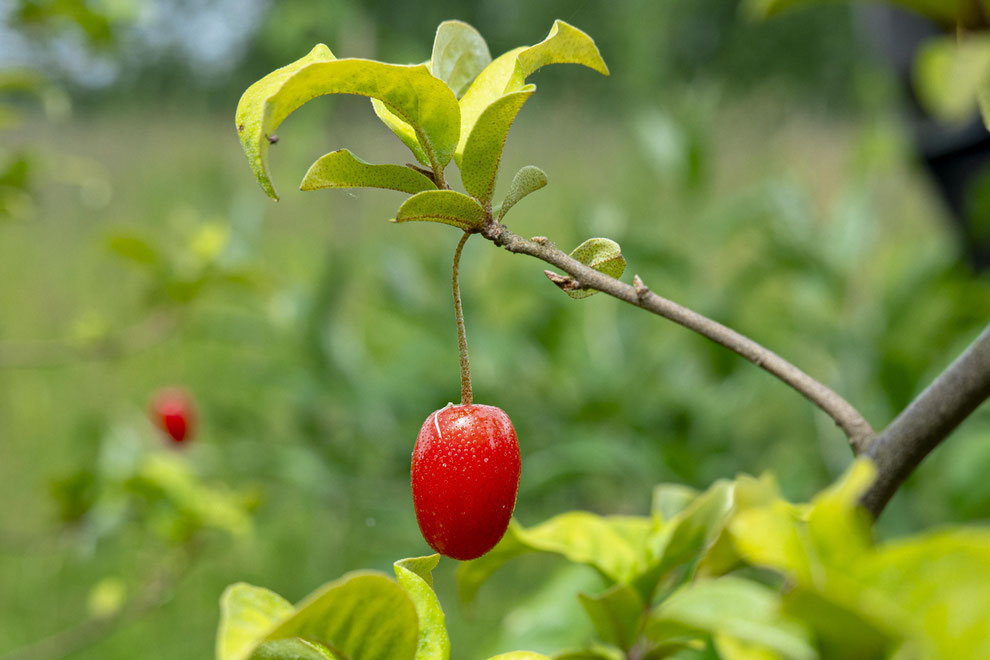
Have you ever seen this fruit? Photo: Adèle Violette
A few weeks ago, I found myself captivated by a fruit I had never heard of.
It was during a conversation with Andreas Motschiunig, who spoke with infectious enthusiasm about the colour, texture, and taste of a berry little known in Western Europe, one he fell in love with at first sight and has been working ever since to promote: the Goumi berry.
Native to East Asia (Korea, Japan, China), the Goumi tree (Elaeagnus multiflora) made its way through Russia and then Ukraine, where new cultivars were developed enough to gradually take root in many private gardens.
And yet it mostly stopped at Europe’s borders which, for growers and admirers, is a surprise considering its long list of desirable traits. Hardy and robust, the shrub requires almost no maintenance. It thrives in poor soil, which it helps enrich thanks to the nitrogen-fixing nodules on its roots. With pale green foliage, it produces fragrant white flowers, and small, glossy red fruits that look like candied berries.
In a happy coincidence (and serious stroke of luck) not only did I discover that June is the perfect moment to taste the Goumi, but that there is actually someone growing them just a short train ride from Brussels, where I live.
Author: Adèle Pautrat, June 2026
"Fruit Trees Like No Other"
And so it does not take much persuasion for my colleague Natasha and I to set off, just a few days after speaking with Andreas, to meet Piet Barbieux, the man who helped bring the Goumi to Belgium.
It’s sunny when we arrive in Rhode-Saint-Genèse, home to Piet's nursery, Bois de Rode Bos. The weather is warm and a little damp. The morning light casts a beautiful glow across the trees which line a small dirt path running alongside the nursery leading us up to the entrance. A few metres further on, we are greeted by the barking of June, a border collie, followed by a warm welcome from Piet and his colleagues.
Tree nursery does not do the place justice. Think more jungle treasure trove, a lush living library of edible biodiversity with carefully collected rare and unusual fruit trees from across the world, growing side by side.
It would be all too easy to lose the morning (and afternoon and evening) to wandering around the garden, but our sights are set firmly on the Goumi. "Let's go to the other side," says Piet, leading us away to a neighbouring field as he tells us about his journey.
About 12 years ago, he found this plot of land to dedicate to his passion: the development and cultivation of rare and unusual fruit tree species suited to Belgium’s temperate climate.
“Little by little, I found myself drawn into a somewhat underground community of collectors – people who chat on forums about plants they find all over Europe,” he says.
Over the years, Piet built up an impressive collection of his own and, as interest from local visitors grew, so did requests for plants, which eventually led him to set up the nursery.
He and Andreas met through these self-described “nerd” networks. It is through that connection that Piet received his first Goumi plants from South Korea a couple of years ago, along with several cultivars developed by Andreas himself.
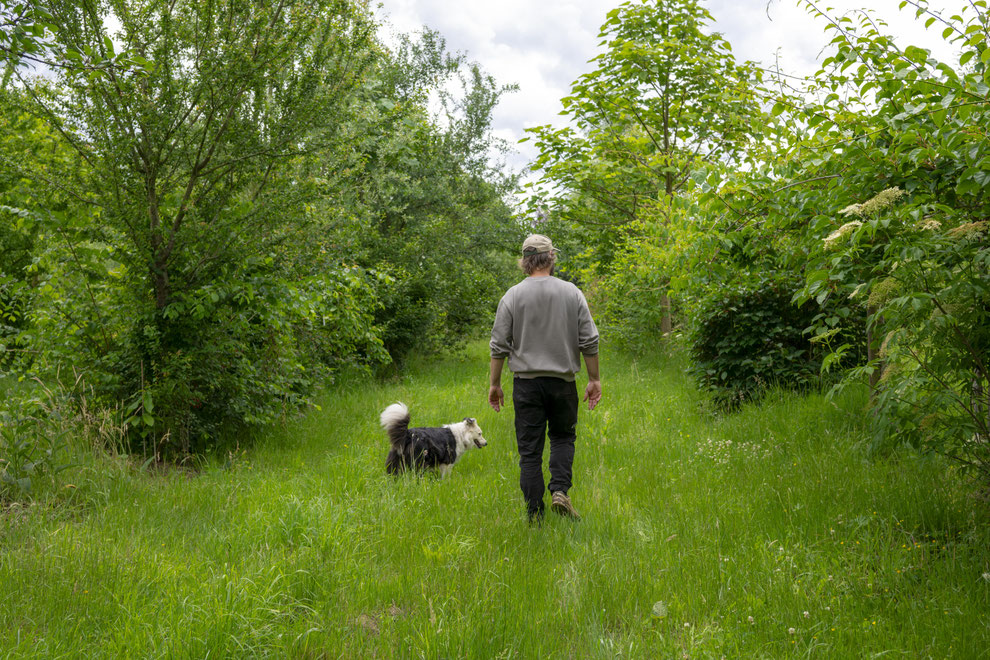
Piet and June in the nursery's gardens. Credit: Adèle Violette
The Magic of Tasting a Fruit for the First Time
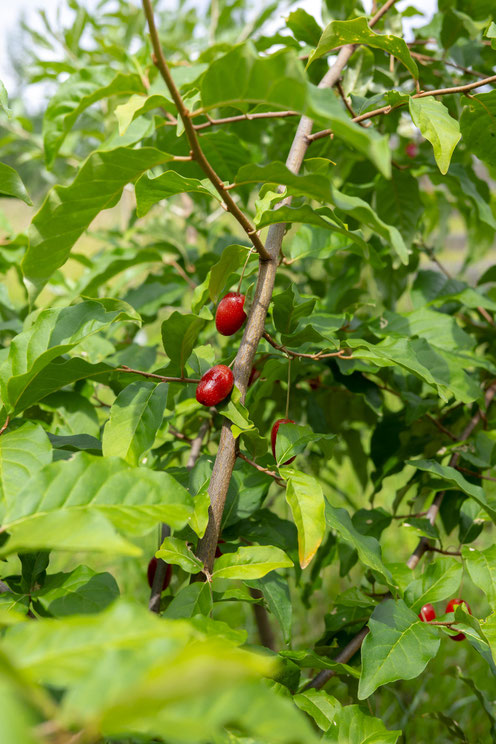
Finally we stop in front of the trees, smaller than us, but thick. Scattered among their pale green leaves are flashes of bright red: Goumi berries.
There is something magical about encountering a fruit for the first time. Picking it, observing it, feeling its texture, breathing in its scent, tasting it. I realised I could not remember the last time I had been given such an opportunity. The experience felt strangely childlike, reconnecting me with that state of curiosity and wonder that so often accompanies discovery.
If it’s hard to describe the feeling, I can assure you it’s even harder to describe the taste of something that has nothing to compare it to. But let me try.
The Goumi fruits vary in size depending on the cultivar, but they fit comfortably in the palm of a hand. At first glance, they resemble wild cherries. One friend, looking at a photograph later, described them as "somewhere between a cherry tomato and a strawberry". Their red is lighter and brighter than either, however, almost luminous against the foliage.
Their skin is slightly rough to the touch and speckled with tiny silver dots that shimmer in the sunlight. Even the seeds are elegant — long, slender and delicately grooved.
When I finally put the fruit in my mouth, anticipation gives way to surprise. My first sensation is a burst of soft, juicy and remarkably airy flesh, almost cloud-like in texture.
Again, the sweetness brings cherries to mind more than any other red fruit. Yet the resemblance is faint. Goumi is gentler, fluffier and more delicate, balanced by just enough acidity to keep it fresh.
Once in the mouth, the skin proves surprisingly thin. So delicate that it melts on the tongue very quickly, perhaps even too quickly, because in a few seconds it’s already gone.
The fruit I have just described is the Korean variety grown by Piet, but he has collected others – some smaller, often a similar colour, sometimes tending more towards yellow, but more acidic and, above all, much more astringent – although most likely because they weren’t quite ripe enough, as Andreas had warned me.
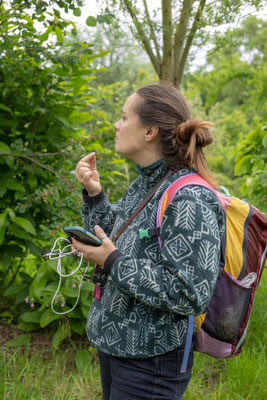
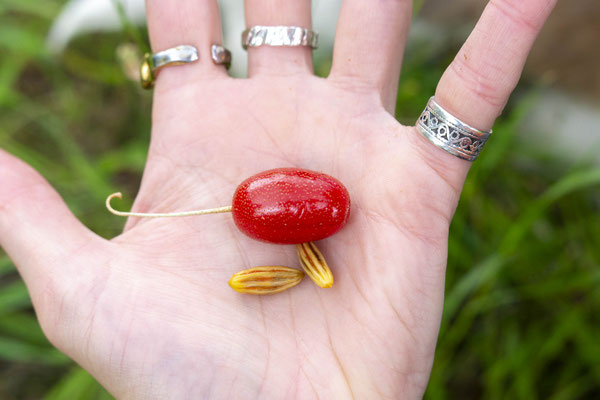

From left to right: Natasha tasting a Goumi. Goumi berry tnad their seeds. The very young fruits of a variety that ripens later. Photo: Adèle Violette
Beyond Commercial Value
We can’t leave without doing a round of the garden, every turn unveiling plant species that most of us rarely encounter. Such as a dwarf kiwi plant, an Amelanchier alnifolia, or some fleshy mulberries (see pictures below).
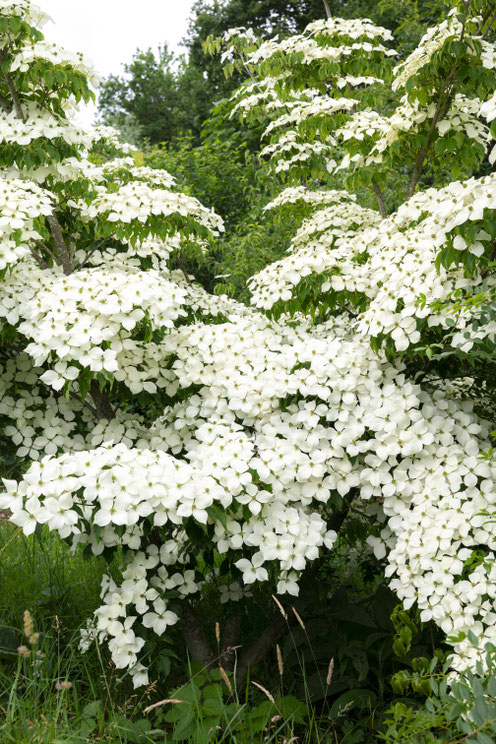
At the end of a path, we come across a tree covered in white leaves of an almost spellbinding beauty – the Cornus kousa. “Is it edible?” we ask in astonishment, to which a bemused Piet replies that everything here is edible.
A few hours later, as I leave Rhode-Saint-Genèse, I feel both fortunate and slightly amused. After all, how often does someone in their thirties, living in a city and growing none of their own food, get to taste an entirely new fruit?
It’s not like supermarkets regularly refresh their displays for offering us new taste experiences rooted in plant diversity. In fact, it’s quite the opposite: uniformity reigns in the industry.
The story of the Goumi berry — and indeed the existence of Bois de Rode Bos itself — suggests a different reality. Thousands of fruits with a variety of flavours can grow in our regions. On the one hand, just within touching distance; but on the other, so inaccessible to the vast majority of us.
Why? Partly because they have no commercial value to the dominant agroindustry model, for which crops like the Goumi are too fragile to be harvested by machines, or transported on an industrial scale.
The magnificent Cornus Kousa. Credit: Adèle Violette.
These crops have no place in a system that rewards scalability and market efficiency, but their marginalisation does not reflect their ecological, cultural, or nutritional value.
Yet, as they vanish from fields, orchards, and markets, they also disappear from our collective imagination. And most of us remain unaware of the flavours, textures, and sensory experiences that we have been robbed of by the commercial logic.
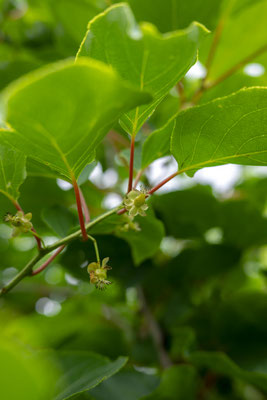
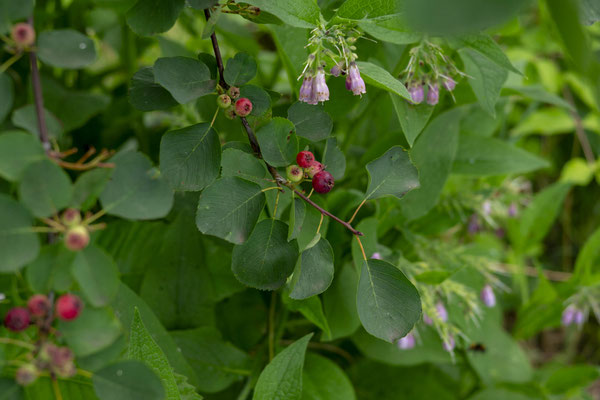
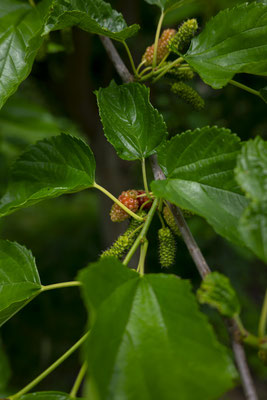
From left to right: dwarf kiwi plant, Amelanchier alnifolia, and fleshy mulberries. Photo: Adèle Violette
New Paths for Diversity to Reach our Plates
In the days following my visit to Rhode-Saint-Genèse, I find myself telling the story to almost everyone I meet. The photos I post on social media generate lots of reactions, all of them reflecting the same sense of wonder that I experienced when I tasted the Goumi.
People recall little-known plants they once encountered in a family garden, on holiday, or in childhood, that got lost somewhere along the way. The feeling emerging from these conversations is a curious blend of joy and melancholic nostalgia – delight at having known such diversity, and frustration at how inaccessible it has become.
This strengthened my conviction that most of us actually care for diversity, when we are concretely brought back to what it represents, not only in theory, but through our senses, our memories and our emotions.
So what kinds of parallel systems might help us reconnect diversity with our everyday experience? What alternatives could broaden our access to the immense range of flavours, textures and aromas offered by the plant world without relying solely on the logic of large-scale commodification and profit maximisation?
As I write this, I find myself picturing a publicly supported local network that would connect the Bois de Rode Bos with nearby school canteens and collective kitchens to make sure that the rare fruits find their way onto local people's plates.
It would be a small but important step towards raising children’s awareness of edible biodiversity, and inspiring them to nurture it – in the broadest sense – once they’re old enough to remember the flavours that are missing from their supermarket shelves.


All the photographs on this website were taken by professional photographers and are protected by intellectual property rights.
If you wish to reproduce them, please write to us and we will provide you with the necessary information. Thanks!